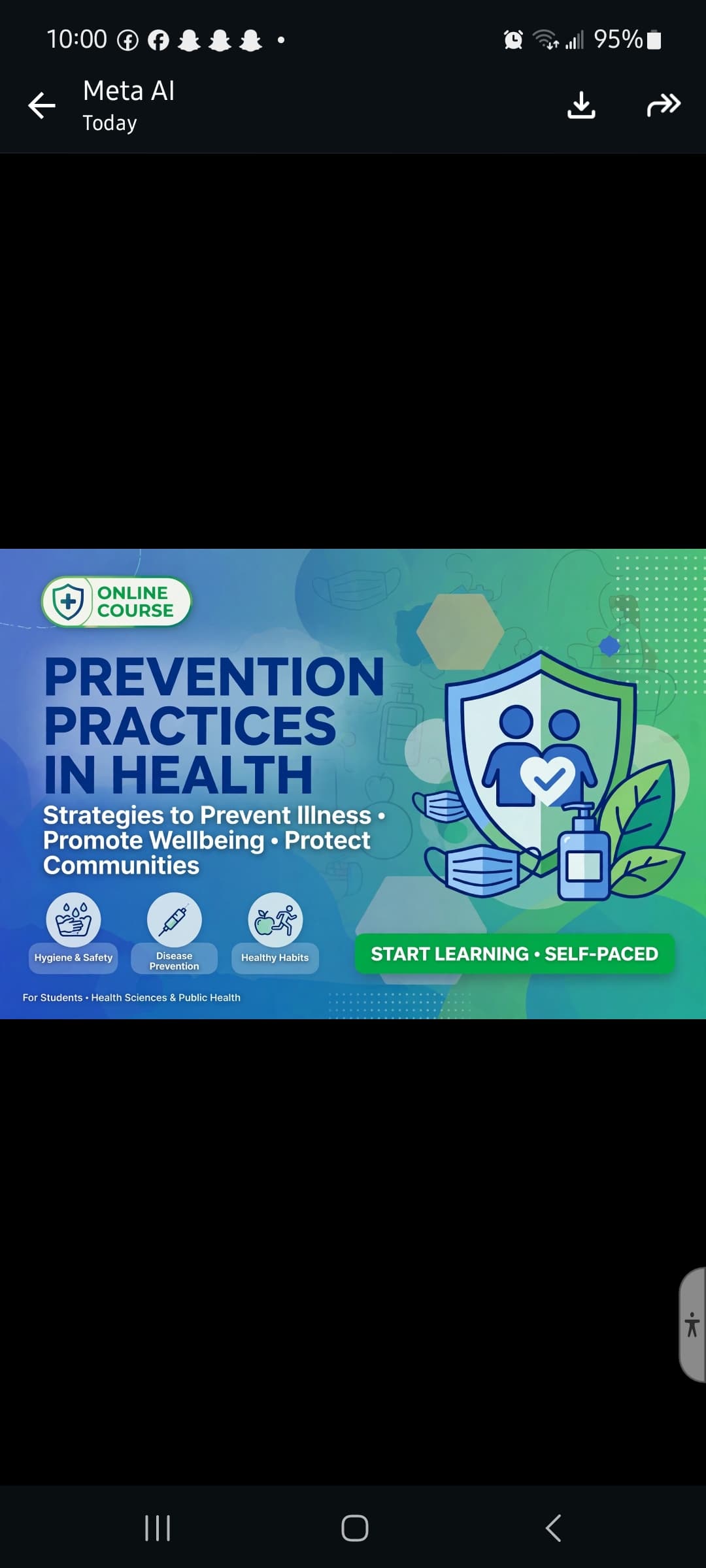
This is a core course in Public Health, Nursing, Community Health, and Health Education. It's usually called *Preventive Health / Principles of Disease Prevention*.
1. About the Course
The course teaches students how to keep individuals, families, and communities healthy, rather than just treating them after they fall sick.
It covers the chain of infection, levels of prevention, health promotion, immunization, nutrition, sanitation, and control of communicable and non-communicable diseases.
Main topics include:
- Concepts of health and disease
- Levels of prevention (Primary, Secondary, Tertiary)
- Personal, food, and environmental hygiene
- Immunization schedule
- Maternal and child health prevention
- Prevention of malaria, cholera, typhoid, HIV/STIs, hypertension, diabetes
- Health education and community mobilization
2. Benefits of the Course
*For the student:*
You shift from curative thinking to preventive thinking
- You learn practical skills you can use at home and in the community immediately
- It's the foundation for jobs in public health, NGOs, WHO, UNICEF, and community health programs
*For the community:*
- Reduces hospital visits and cost of treatment
- Reduces death from preventable diseases (most deaths in Cameroon are preventable)
- Increases productivity because healthy people work and study better
- Builds trust - communities listen to health workers who teach prevention
*For the health system:*
- Cheaper to vaccinate 100 children than to treat 100 children for measles
- Reduces overcrowding in hospitals
3. Learning Outcomes
By the end of the course, a student should be able to:
*Knowledge:*
- Define health, disease, prevention, and health promotion
- Explain the 3 levels of prevention with examples
- List the major preventable diseases in Cameroon
*Skills:*
- Demonstrate proper handwashing technique
- Conduct a health education talk in a community/school
- Plan an immunization or sanitation campaign
- Identify risk factors in a home (dirty water, no toilet, mosquito breeding sites)
*Attitude:*
- Promote healthy behaviors in their own family
- Advocate for vaccination, clean water, and hygiene
- Take responsibility for community health, not just individual patients
In short: *A doctor treats one sick person. A preventive health worker prevents 1,000 people from getting sick.*
Do you want me to break it down into notes for each topic, like for an exam?more about your course, its benefits, and learning outcomes